For firms with more AI ideas than time
Know which AI idea to fund first, and prove it paid off.
The Automation Hub turns workshop ideas into a ranked portfolio: the value measured before, the process fixed before anything is built, and the result measured after.
Calculate what waiting costs youDemo with sample data · your own portfolio after the workshop · people decide, AI prepares
Automation potential
What is standing still costing you?
Most of the value of automation is not in year one. It builds as the change beds in, so the month you start decides how much of it you keep. Set your business, see the running cost before and after, and what a delay takes off the table.
Your business
Suggested for your size. Run cost assumed at 20 % of it per year.
Ease of implementation Harder: standardise first
- Saved per year, full effect
- A$779.6K
- Capacity freed
- 7.1 FTE
- room for 16 % more work without hiring
- Pays back in
- month 9
- Net value over 3 years
- A$1.3M
The cost of standing still
Starting 6 months later costs about A$382.8K over three years, ≈ A$63.8K for every month of waiting.
The savings do not wait for you: the curve only starts when you do. The investment stays the same; the years of benefit get fewer.
Running cost of process work, before and after · per year
Cumulative net value · 36 months
Whole business today: A$5.1M a year in people and systems, of which A$2.2M is people time on process work.
Where the numbers come from. The technical ceiling draws on McKinsey Global Institute research: about half of the activities people are paid for could be automated with technology already demonstrated (A future that works, 2017), and generative AI with other technologies could automate activities that take up 60–70 % of working time (The economic potential of generative AI, 2023). Those are ceilings, not what a business captures in three years. The industry defaults, the investment, the 20 % run cost and the ramp (faster when processes are standardised) are SMAPAS planning assumptions for small and medium businesses: change them to your figures. Freed time is capacity until it is redeployed or released. An estimate for a conversation, not a promise of results.
Quality
Fewer re-keyed figures and missed steps: errors fall with the manual hand-offs.
Speed
Requests move without waiting for the next free person, so cycle times shrink.
Scale
Freed capacity carries growth, so the next ten clients do not need the next two hires.
Sound familiar?
Plenty of ideas. No portfolio.
Tick what applies. It goes into the conversation, so we start with your situation.
Tick what applies. If you book a workshop, we start the conversation there.
Why use it
From a list of ideas to a programme you can defend
Most firms do not lack AI ideas. They lack a fair way to choose, a reason to trust the numbers, and proof afterwards. That is the gap the Automation Hub closes.
Without it
With the Automation Hub
Without it: A long list of ideas in emails, notes and someone’s head
With the Automation Hub: One ranked list, every idea scored the same way
Without it: The loudest idea gets built
With the Automation Hub: The most valuable, most ready idea goes first
Without it: A messy process, automated and still messy
With the Automation Hub: Waste removed first, then automation where it pays
Without it: “Did it work?” answered with a feeling
With the Automation Hub: Before and after measured, value realised on the record
How it works
One path from idea to measured result
Seven stages, grouped the way we deliver: audit, pilot one process, measure, expand where it pays. Every stage has a short exit check, so nothing reaches a decision half-baked.
- 1
Opportunity Audit
Find the use cases, score them, measure the before and fix the process on paper first.
DiscoverEvaluateShapeDecide
- 2
Pilot one process
Build one narrow Start Here solution in your environment, with the review point in place.
Pilot
- 3
Measure the result
Record the after against the before, with evidence, not impressions.
Measure
- 4
Expand where it pays
Connect more of the process only where the result supports it.
Scale
You decide
AI prepares, people decide.
Every shaped process has a named review point, and only a decision maker can approve, park or stop an initiative.
Simplify before you automate
Eliminate the steps nobody needs, standardise the intake, cut the hand-offs, and only then automate what is left. A messy process automated is a messy process that fails faster.
Inside the app
Built for the person who has to say yes
Six screens carry an idea from the workshop wall to a measured result. Shown here with a sample accounting practice.
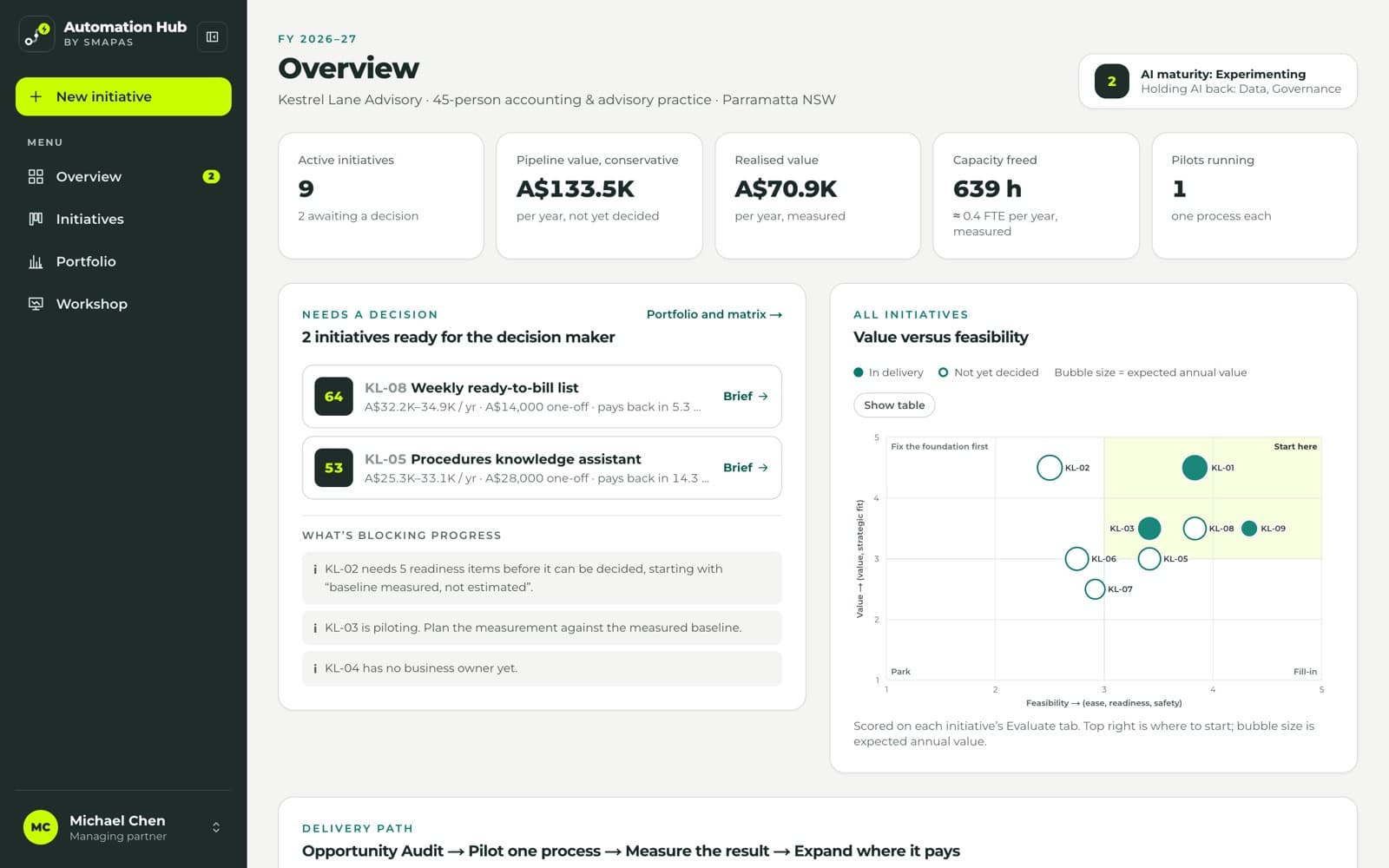
- 01Overview
The whole programme on one screen
Pipeline value, value already realised, capacity freed and what is waiting for a decision.
The owner’s question, “what are we getting for it?”, has a standing answer.
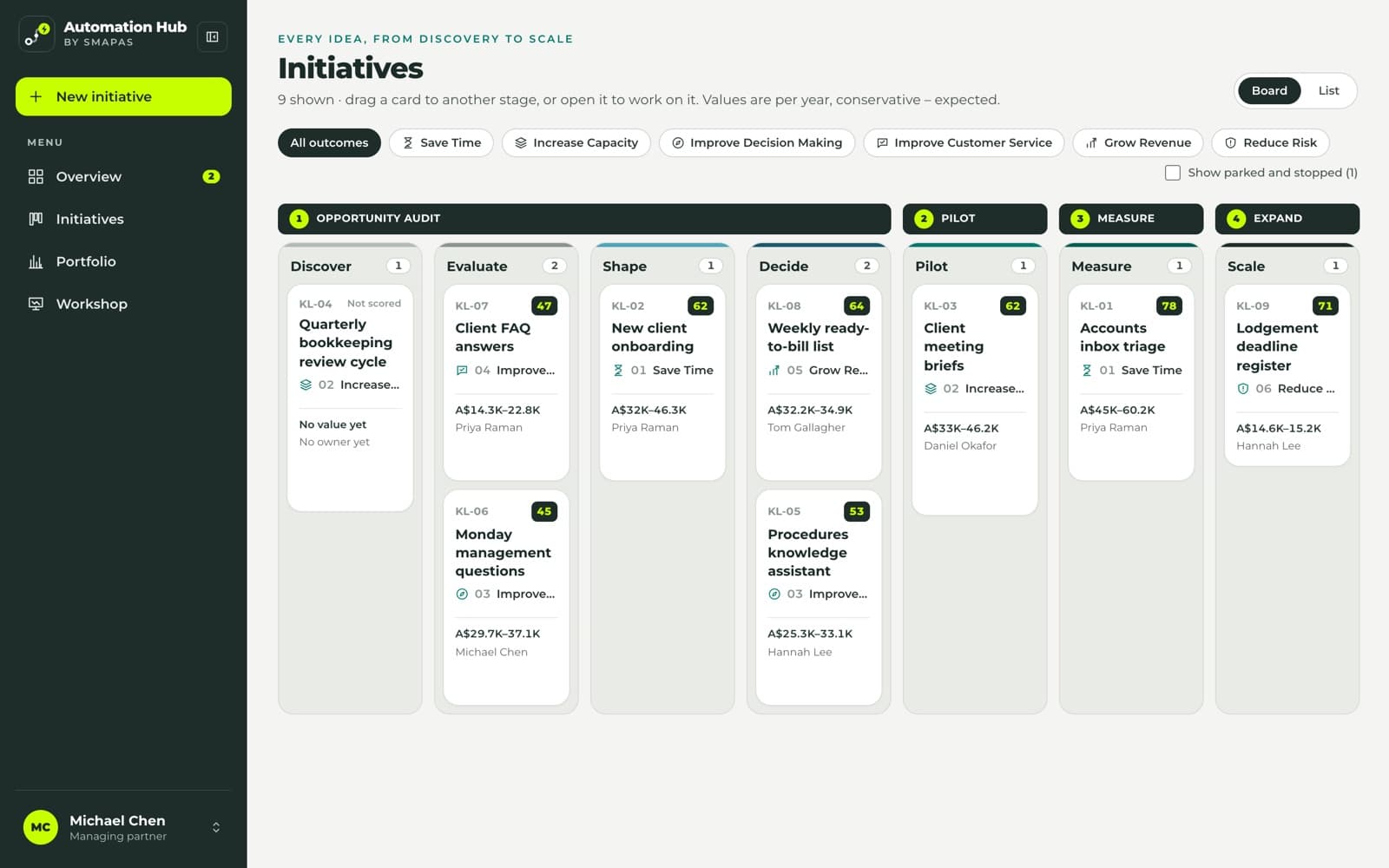 02Initiatives
Every idea on one scale
Value, strategic fit, ease, readiness and risk, 1 to 5 each, with a priority from 0 to 100 and the breakdown always visible.
Ideas are compared on evidence, not on who argues loudest.
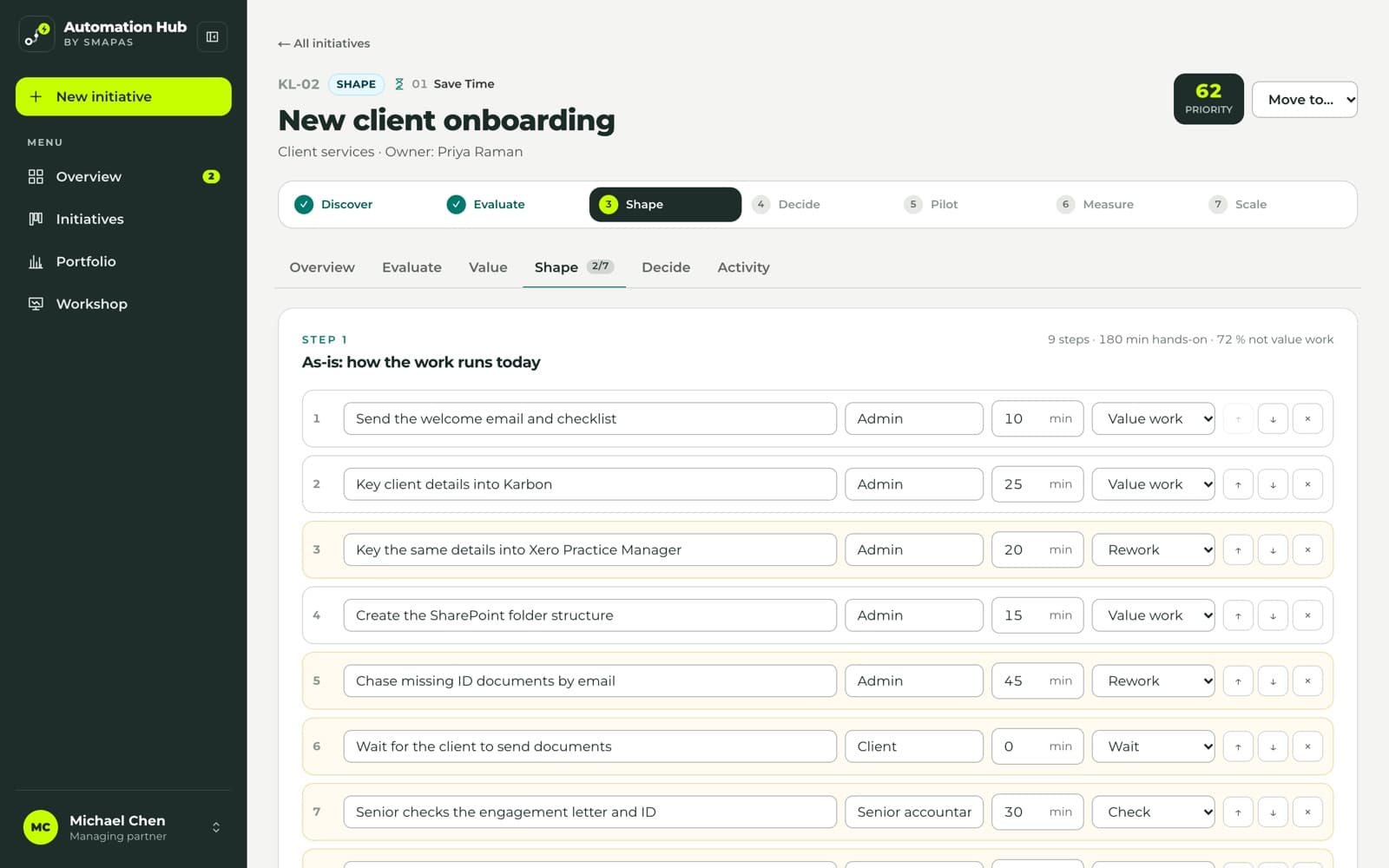 03Shape
Simplify before you automate
Map the steps as they run today, mark the rework, waits and hand-offs, then automate what remains, with a named person at the review point.
You stop paying to automate waste.
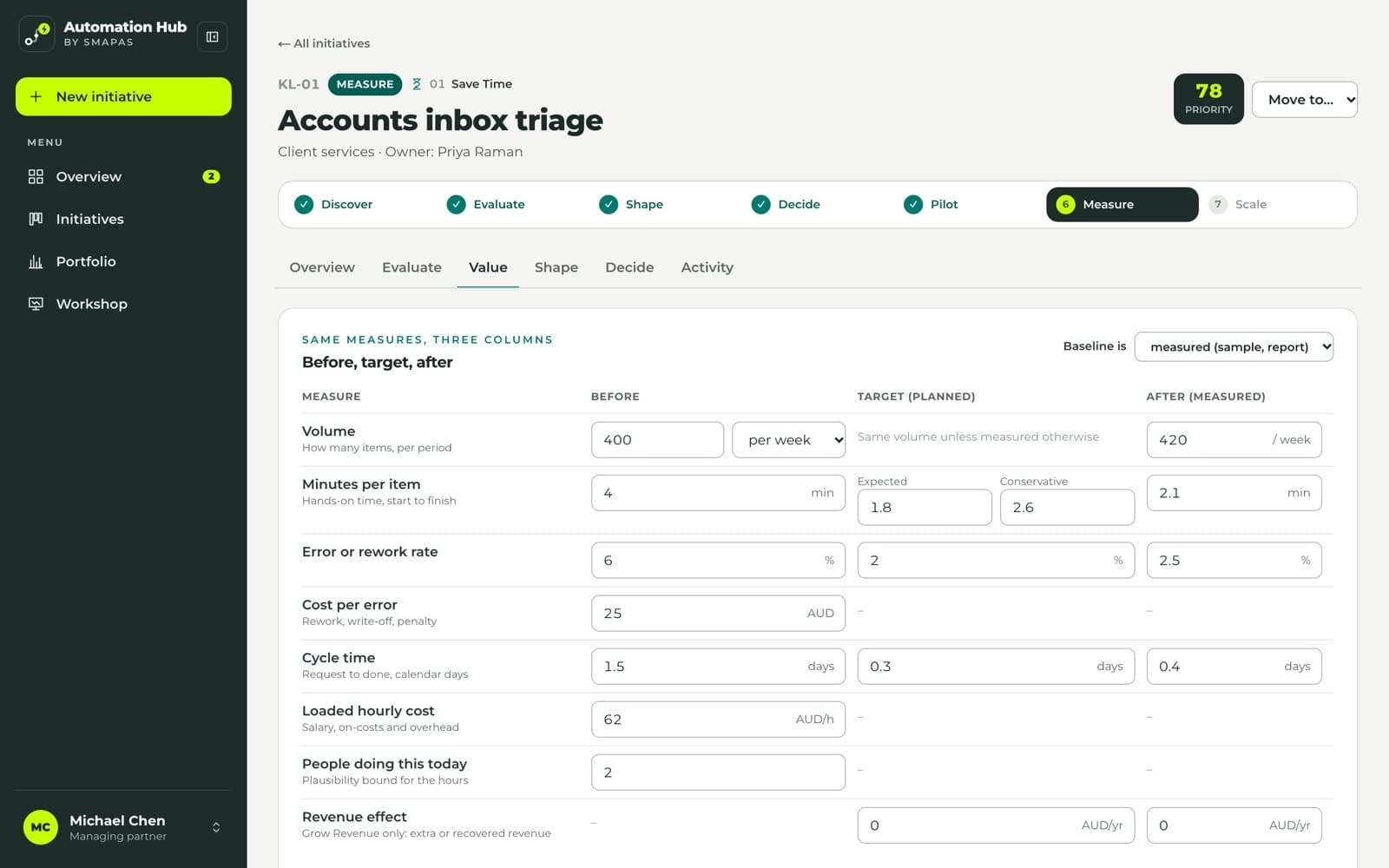 04Value
Before, target and after
Volume, minutes, errors and cycle time in three columns. Ranges, not promises, and capacity is never counted as cash by accident.
The result is measured against a real baseline, so it can be proven.
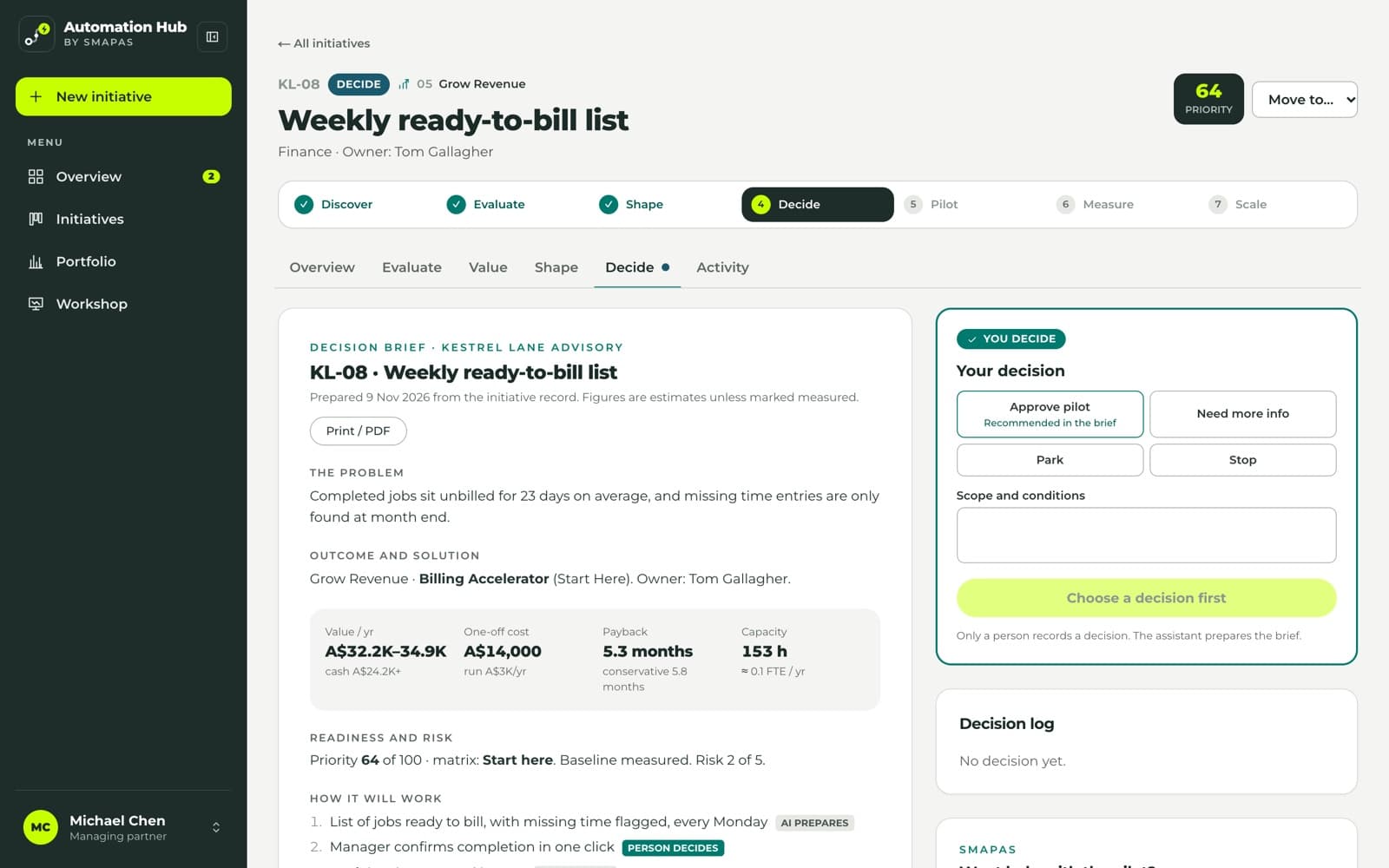 05Decide
A decision brief on one page
Problem, value range, payback, readiness, risks and the ask. Approve, park or stop, with the reason logged.
Decisions take minutes, and nobody re-argues them next month.
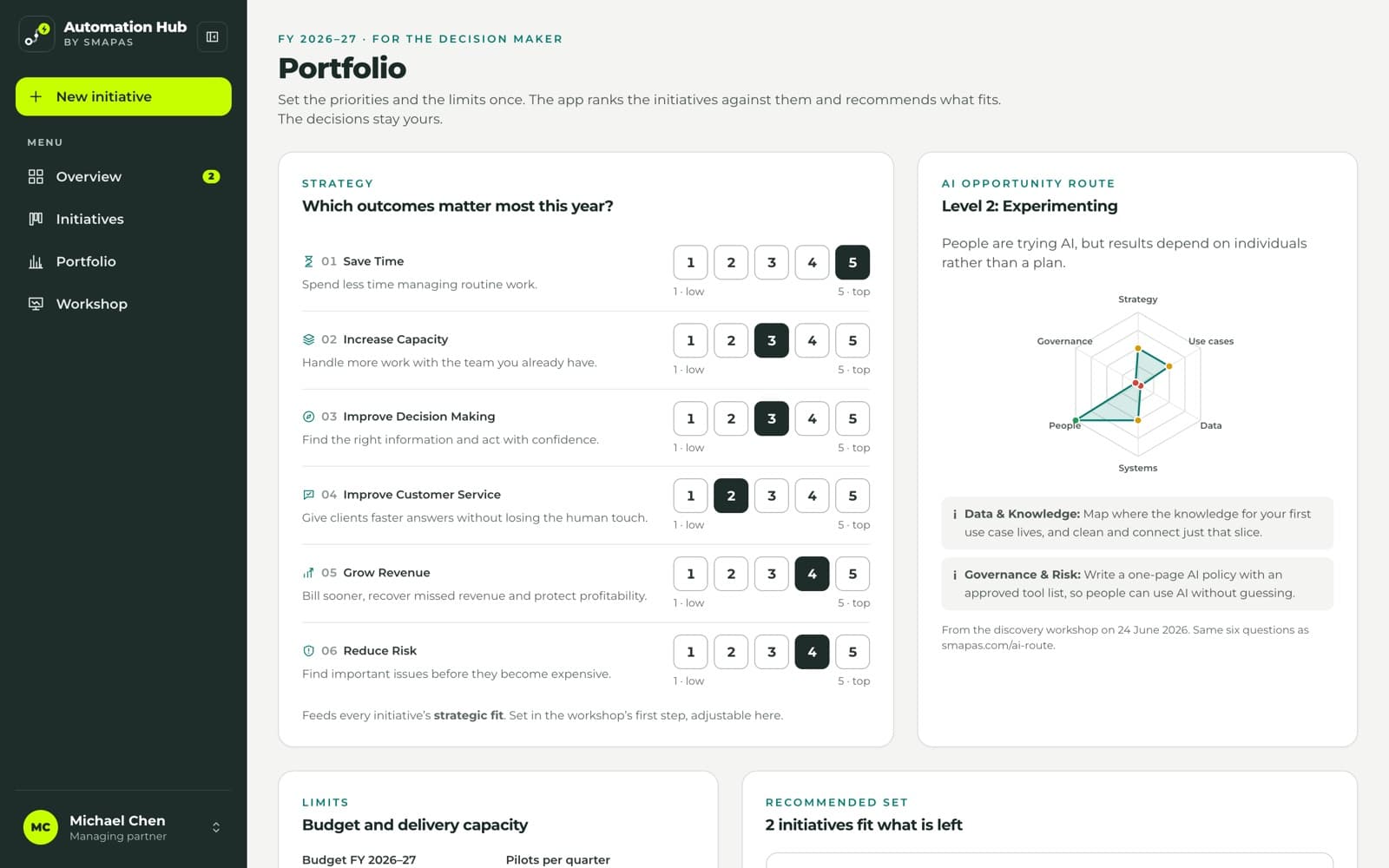 06Portfolio
A portfolio under real limits
Set the year’s priorities, budget and how many pilots the team can absorb. The app recommends what fits.
You fund what the firm can actually deliver this year.
The moment that matters
One page, one decision, on the record
The brief pulls the problem, the value range, payback, readiness and the risks from the initiative itself. The decision maker approves, parks or stops it, and the reason is logged for the next review.
- Value as a range, with the formula next to it
- A measured baseline before anything is approved
- AI prepares the brief; only a person records the decision
Ways to start
Start in a workshop, keep the portfolio
- 01
Discovery workshop
We run it with your team, on your real work. You leave with a ranked portfolio, a baseline plan and three owners.
- 02
Try the demo
A sample accounting practice with ten initiatives in every stage. Score, value, shape and decide for yourself.
- 03
Your own portfolio
After the workshop your team signs in to the same initiatives and carries them through pilot and measurement.
- People stay in chargeAI suggests. Your team accepts, rejects and decides.
- Measured, not promisedRanges, visible formulas, and a measured baseline before any decision.
- Works with what you haveMicrosoft 365, Xero, Karbon and the systems you already run.
Questions
Before you ask
Is this a project management tool?
It covers the part before and after the project: which initiative, why, what it is worth, and whether it delivered. The build itself runs wherever you run projects today.
Where do the use cases come from?
From your team in a discovery workshop, from the AI Opportunity Route, or added any time with the capture wizard. Each is mapped to one of six business outcomes.
Does the AI decide what we do?
No. The assistant suggests outcomes, process improvements and wording. People accept or reject every suggestion, and only a decision maker records a decision.
How reliable are the value figures?
Every estimate is a range, the formula is shown next to it, and implausible inputs are flagged. Before a decision the baseline has to be measured, not estimated.
What happens to our data?
The demo stays in your browser. Your own portfolio is stored in the SMAPAS portal under your organisation, visible only to the people you invite.
Which of your ideas would create the most value?
Bring the list. We leave you with a ranked portfolio and a measured place to start.